Memory Recall
Memory Recall
2025–2026. Three-channel synchronised video installation, 4-minute loop. Also presented as a single-channel video artwork.
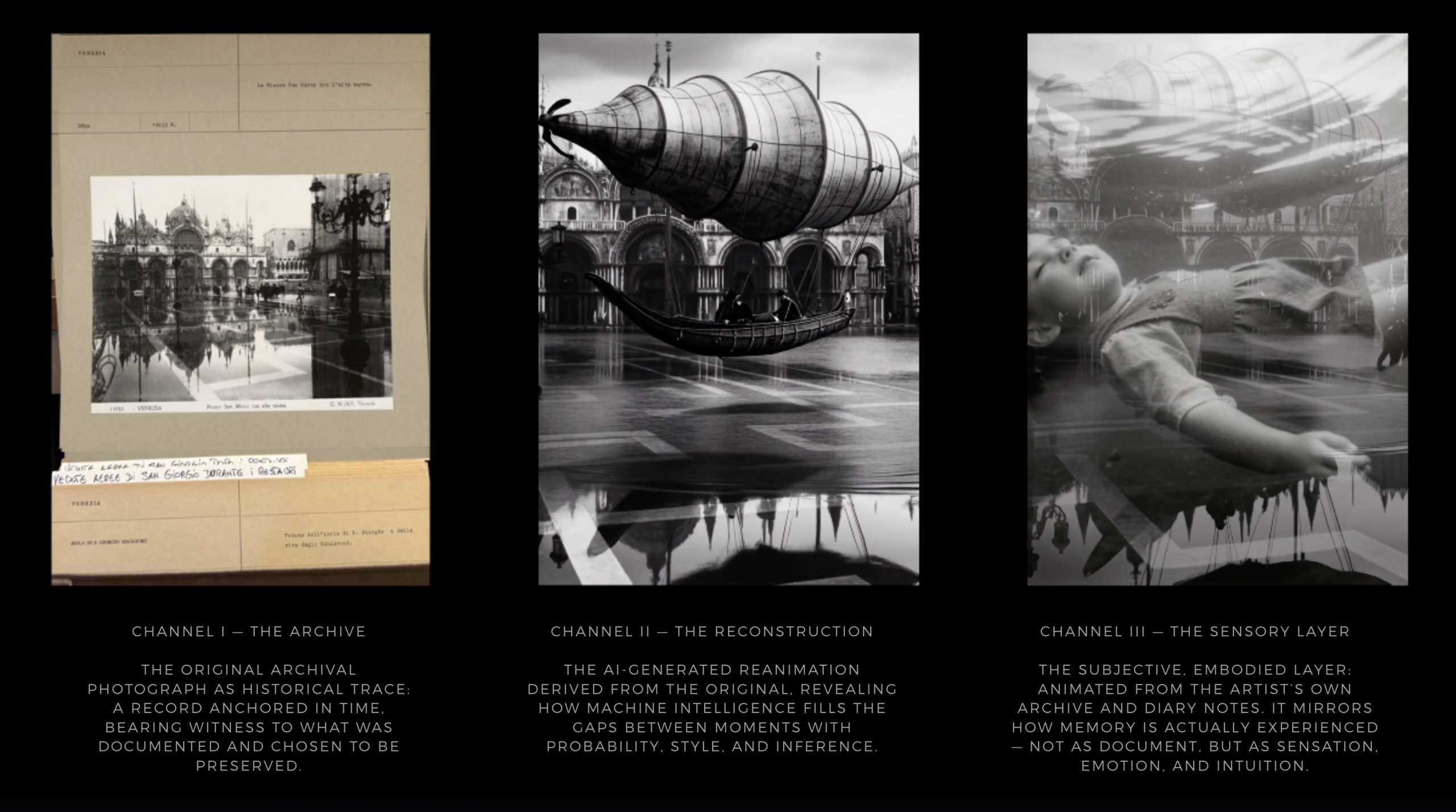
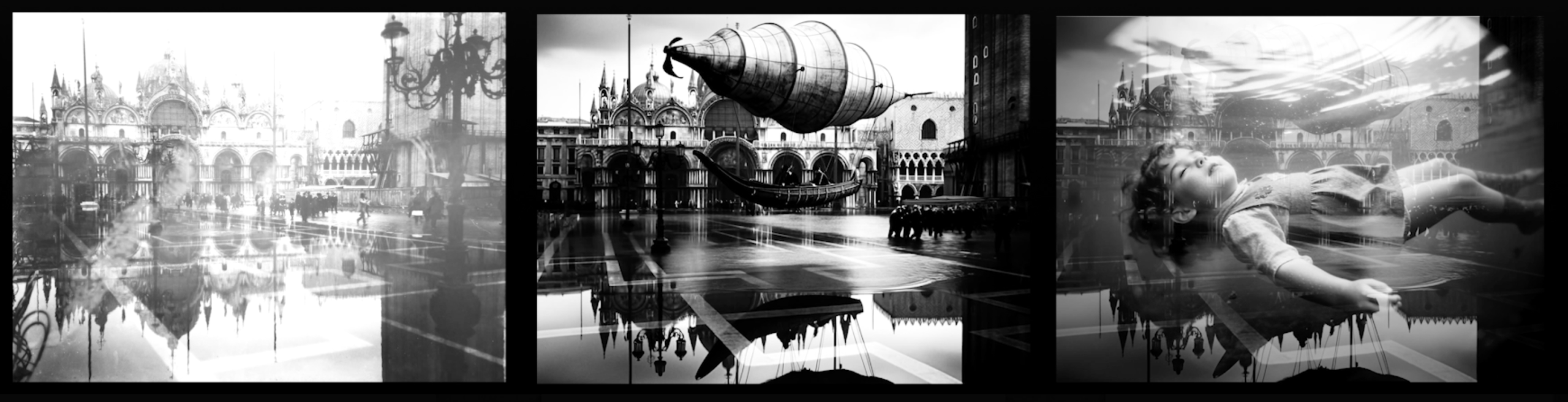
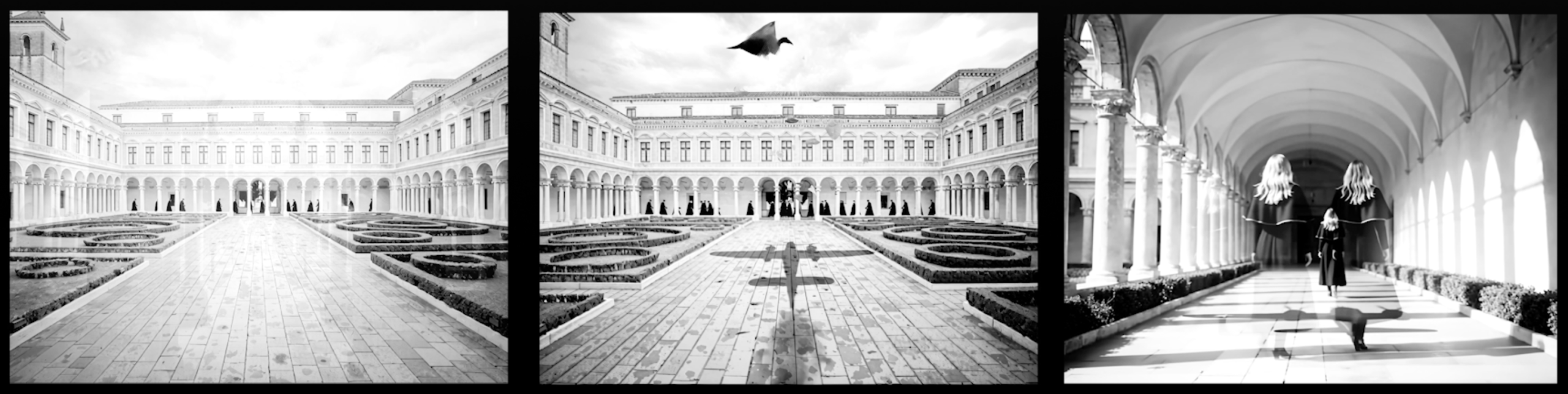
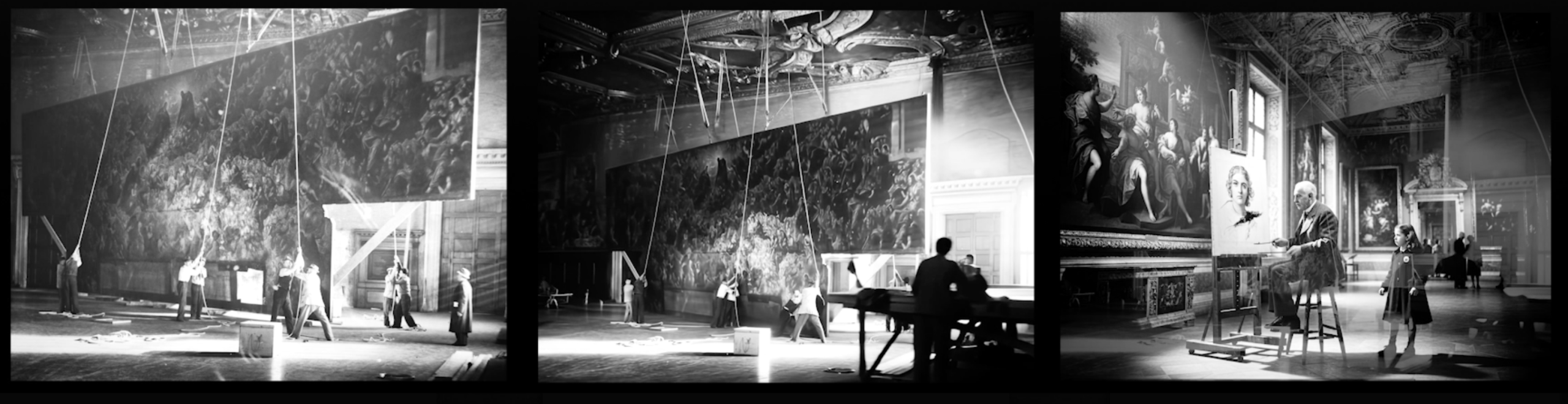
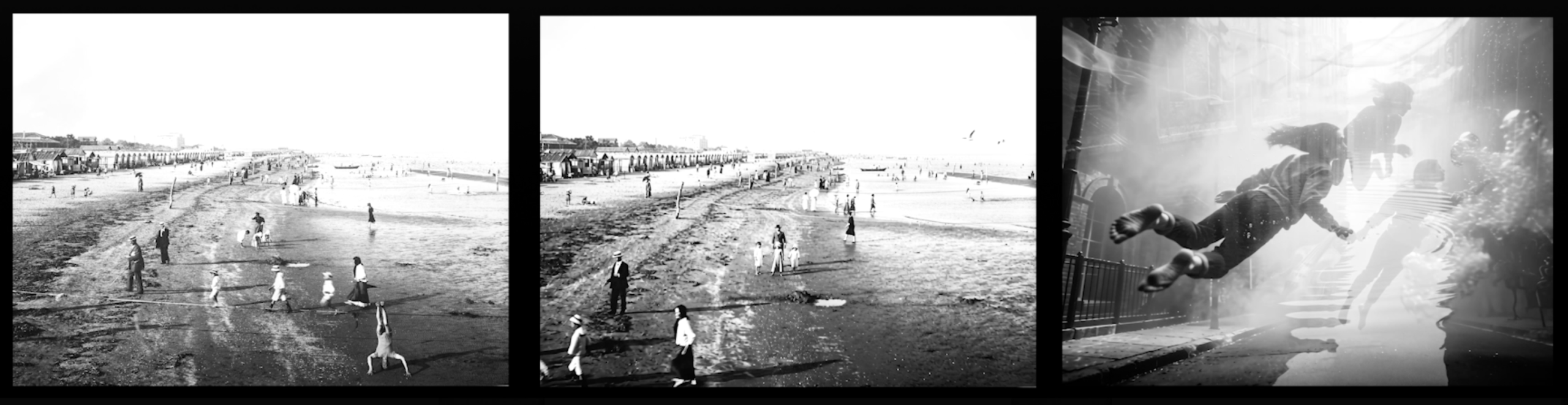
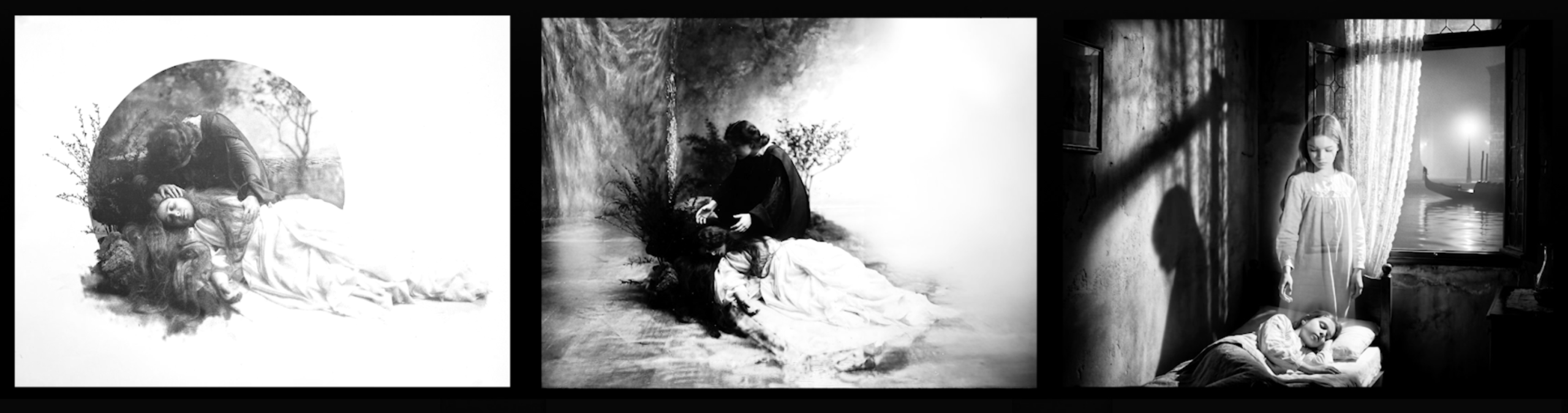
Memory Recall is a four-minute video artwork and a triptych, three-channel video installation built from archival photographs of the Fondazione Giorgio Cini, Venice. It began during the D.A.I.R. Digital Artist in Residence programme in September 2025 and was completed in March 2026.
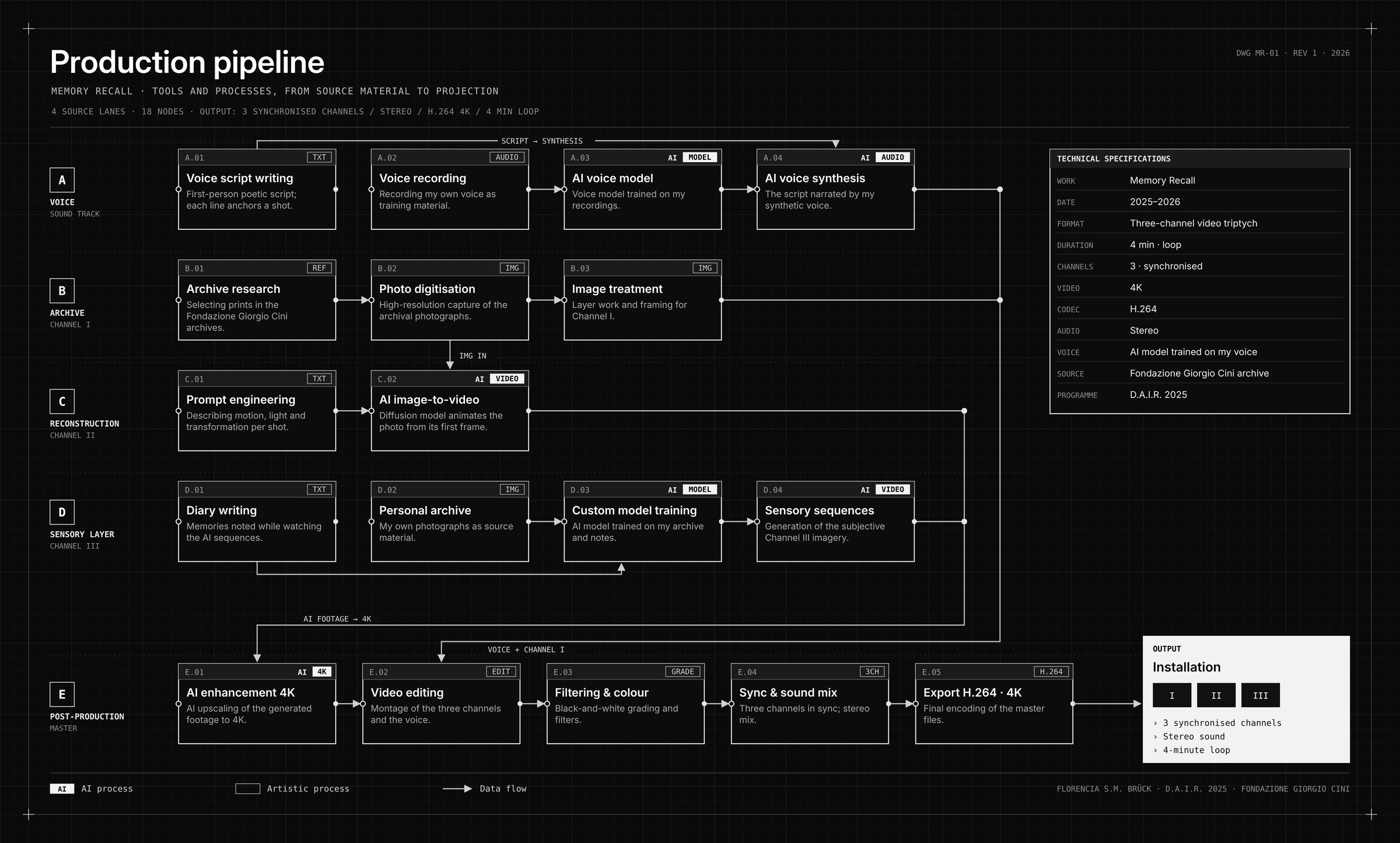
The project began as a reflection on how memory forms and transforms over time, alongside the growing use of AI animation to reanimate historical images. From this inquiry, Florencia wrote a script and recorded a voiceover using an AI model trained on her own voice.
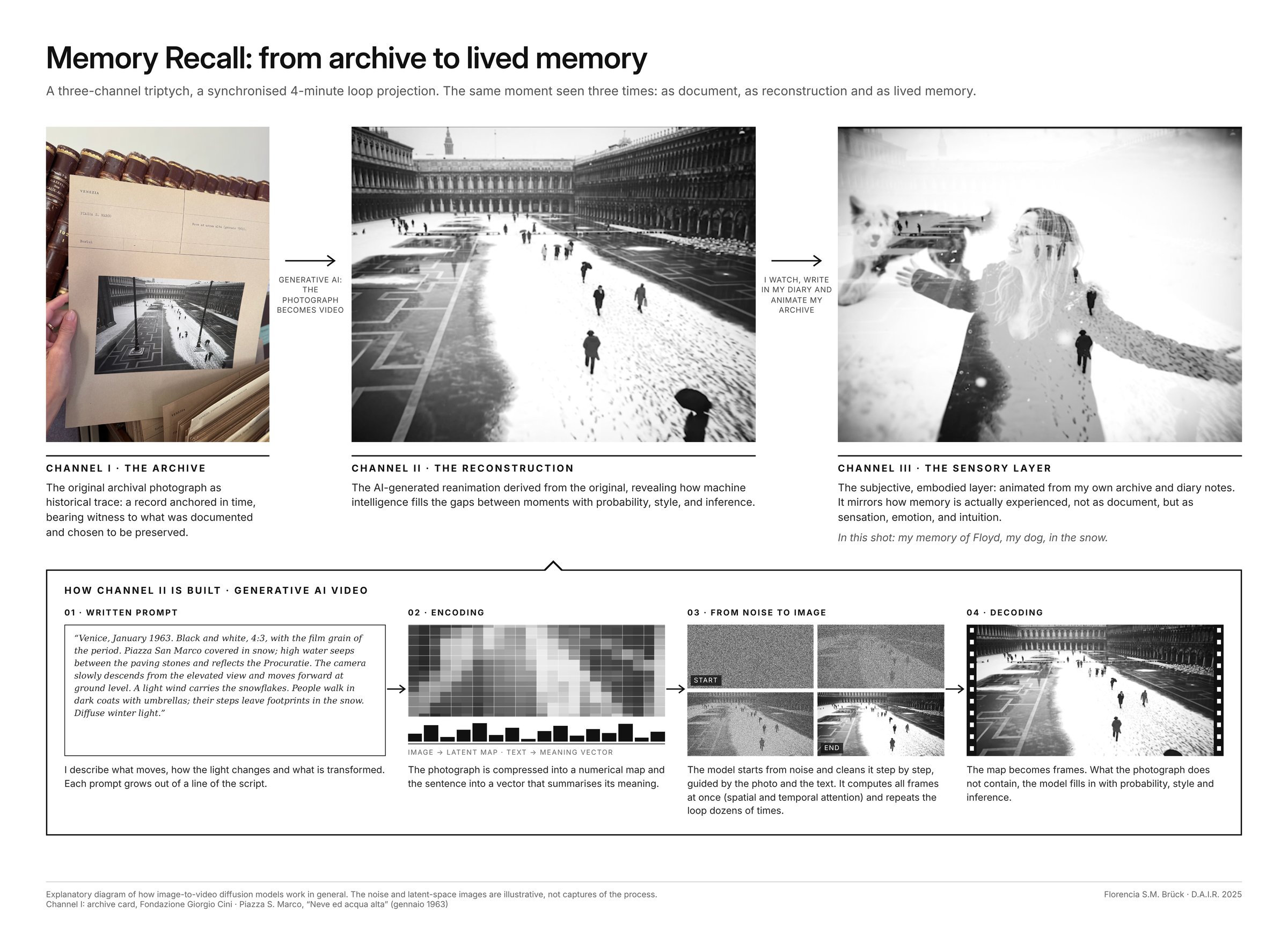
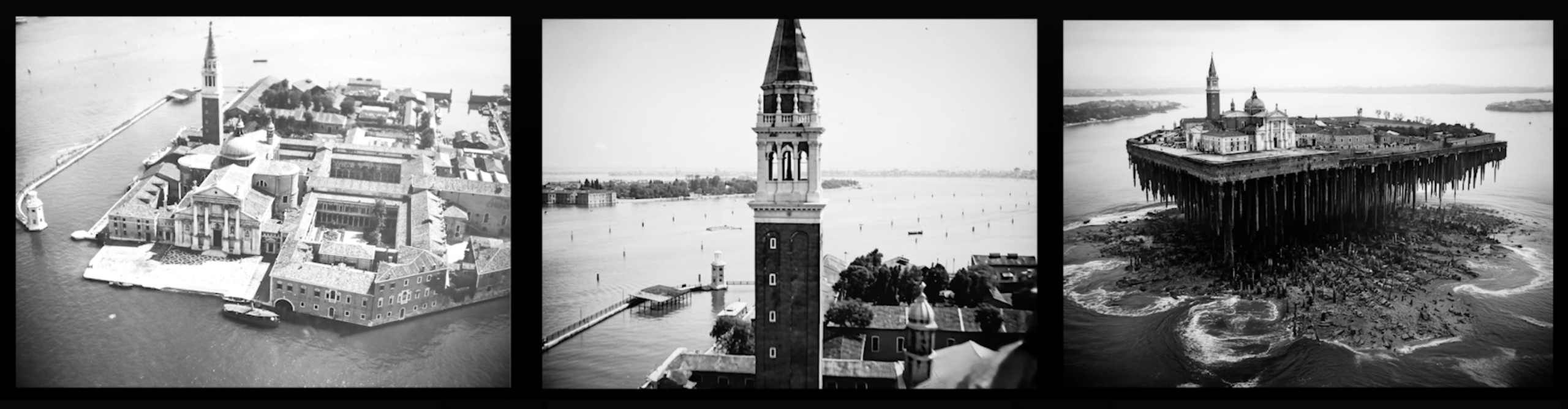
Entering the Foundation’s photographic archives, she selected images that resonated with the script. These photographs form the first channel, presented as historical traces. In the second channel, the same images are animated through AI, generating speculative extensions that move beyond what the photograph contains.
While observing these sequences, she wrote in her diary the memories and sensations that surfaced. Drawing from her own photographic archive and these notes, she trained a custom AI model to animate fragments of her own memories. This became the third channel: a subjective layer that evokes what archives cannot store, emotion, intuition and embodied memory.
What this work asks
What survives in an image? What does a machine perceive when it looks at the past? And can an intelligence without a body ever truly remember?
Current AI systems, however sophisticated, are structurally blind to the sensory, emotional and embodied dimensions of human memory. What a machine reconstructs from an image is pattern and probability. What a human remembers is smell, weight, grief, warmth. That missing layer is not a technical limitation waiting to be solved; it is a fundamental difference in the nature of knowing.
Rather than a linear narrative, Memory Recall unfolds as a constellation, echoing how memory itself behaves: fragmentary, recursive, coloured by emotion and time. The third channel exists precisely to name what the algorithm cannot reach: the memory that moves through the body’s genetic code, that gathers in rituals and gestures passed from hand to hand, that lives not only within us but between us. The memory that has no image, and yet endures.
Production pipeline
From source material to projection: the voice, the archive, the AI reconstruction and the sensory layer converge in post-production into a synchronised three-channel work, exported in 4K.
Narration
Voiceover written by the artist and recorded using an AI model trained on her own voice.
Here, in this monastery,
I walk through cloisters built for silence.
What was once a house of prayer now shelters the archives.
These walls hold centuries, like breath held in stone.
This place was reborn from a father’s grief,
a son’s life broken in mid-flight.
From that wound he shaped not stone for mourning,
but a living archive,
so that memory might endure where life could not.
Every place and event carries the record of its time,
written with the tools and technologies at hand.
And the way they are recorded
determines how they will be remembered.
The outcome of a war is less gunpowder than pen.
In the Refectory, where Veronese’s Wedding at Cana once stretched across the wall,
there is only its echo,
a facsimile restored to the place it was meant to live.
Because here, memory is not in the pigment,
but in the dialogue between image and place.
Memory does not preserve the past as it was.
It reshapes it each time it is recalled,
shifting with perception, with emotion, with imagination.
The past is not behind us.
It is alive within us.
It awakens when summoned,
by a glimpse, by a word,
by the mandarin fragrance you thought forgotten,
by a song that still echoes in your chest,
by the salt of the sea upon your lips.
Memory lives not only within us, but between us.
It gathers in rituals and dances,
in sites and landscapes,
in gestures passed from hand to hand.
There is no single truth.
Even death does not dissolve it.
It moves through the body’s genetic code,
a whisper of those who came before.
Memory defines the shape of our lives.
It gives the present its context,
resonant with everything we have lived,
woven into the story of who we are.
And I wonder,
what kind of memory will you leave behind?
Archival sources
Archivio Eleonora Duse, Istituto per il Teatro e il Melodramma, Fondazione Giorgio Cini.
Archivio Aurél M. Milloss, Istituto per il Teatro e il Melodramma, Fondazione Giorgio Cini.
Raccolta su schedoni, Fototeca dell’Istituto di Storia dell’Arte, Fondazione Giorgio Cini.
Special thanks
D.A.I.R. Evaluation Committee:
Chiara Casarin, Ennio Bianco, Veronika Liebl, Luca Massimo Barbero, Sara Tirelli, Valentina Venturi, Centro Digitale — ARCHiVe, Fondazione Giorgio Cini.
Marianna Zannoni, Istituto per il Teatro e il Melodramma, Fondazione Giorgio Cini.
Monica Bassanello, Fototeca dell’Istituto di Storia dell’Arte, Fondazione Giorgio Cini.
Eva Salviato, Centro Studi di Civiltà e Spiritualità Comparate, Fondazione Giorgio Cini.
Marta Zoppetti, Centro Vittore Branca.